Original source: http://www.bbc.co.uk/sport/rugby-union/57346563
https://therugbystore.com.au/premiership-sale-45-12-harlequins-sharks-win-keeps-top-two-hopes-alive/
Original source: http://www.bbc.co.uk/sport/rugby-union/57346563
https://therugbystore.com.au/premiership-sale-45-12-harlequins-sharks-win-keeps-top-two-hopes-alive/
Brad Thorn is optimistic Suliasi Vunivalu’s latest injury setback is only minor, joking that he’s “quite annoyed” with how well the Queensland Reds winger has taken to his new football code.
Vunivalu hobbled off with a hamstring injury in the second-half of Friday’s 31-24 loss to the Blues ahead of next week’s final round against the Hurricanes in Wellington.
The Wallabies will play three Tests against France next month and Vunivalu would be hopeful his coach’s estimation that “it didn’t look like a massive issue” is on the money.
The former Melbourne NRL flyer has already missed a chunk of his debut season with a hamstring injury, but still mounted a case for a Test cap thanks to a natural transition that has fellow code-hopper Thorn envious.
“He was walking fine. I’d imagine it is grade one,” former All Black lock and Queensland State of Origin forward Thorn said.
“Isn’t he a special (talent) though. I thought it was supposed to be hard to do the transition from league to union.
“I’m actually quite annoyed how well he’s done it.
“I’m appreciating it (as his coach) but the other side of me is thinking ‘far out, I’ve been telling people it’s hard to come across’.”
Vunivalu pulled up sore chasing a kick for what would have been his fifth try in the last four games since returning from injury.
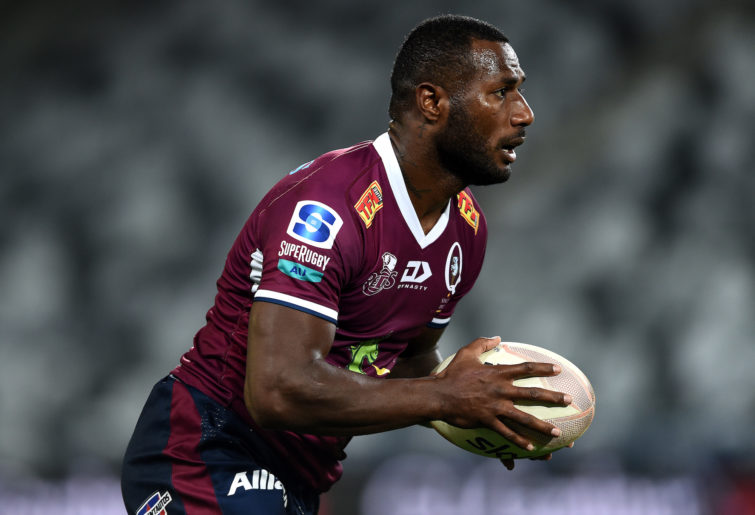
(Photo by Joe Allison/Getty Images)
The winger also showed his poise with another booming in-game clearance kick that found touch, while his defence has been sound.
He even distributed from the ruck when the halfback didn’t arrive and packed down in a scrum on Friday night as the Reds came close to the undefeated Blues at Suncorp Stadium.
That was despite the late outs of James O’Connor (neck) and Bryce Hegarty (hamstring), with 19-year-old fullback Mac Grealy told of his debut while watching NBA earlier in the day.
“He worked hard last year and this year. There were a lot of people in front of him (in the pecking order) but he came in composed, went out there, he mixed it,” Thorn said of the teenager.
Sports opinion delivered daily
“It’s cool that it’s rare now to have a 19-year-old out there having a run, because that was half the team three years ago.”
Thorn also endorsed hooker Brandon Paenga-Amosa for the Wallabies’ end-of-season Tests against the French, despite the fact he will then head to France to play club rugby next season.
“I can see him in the number two for Australia, but that’s only my opinion,” Thorn said of the former Sydney garbage man who headed north in 2018 looking for another shot.
“He’s going to be missed and we just wish him well and thank him for what he’s done here.”
Original source: https://www.theroar.com.au/2021/06/05/thorn-envious-of-vunivalus-transition-after-reds-push-blues/
https://therugbystore.com.au/thorn-envious-of-vunivalus-transition-after-reds-push-blues/
Original source: http://www.bbc.co.uk/sport/rugby-union/57343652
https://therugbystore.com.au/sean-obrien-exeter-chiefs-sign-irish-centre-from-connacht/
The recent floggings of Australian Super Rugby teams by the polished New Zealand outfits re-invites the perennial idea that rugby union is not popular enough in Australia to compete with league, AFL and cricket.
Whilst there are plenty of enthusiastic rugger-loving Australians as documented on The Roar, the same national pride and interest about the Wallabies in comparison to the baggy green, league derbies and AFL is nowhere near as passionate since 2003. Given how proud and competitive Australia is as a leading sporting nation, after cricket, rugby union is the second sport Australians can boast and look forward to competing with other rival nations such as NZ, England and South Africa.
This surely should be an incentive for more citizens to be interested in an international game. The perceived lack of interest comes from a number of factors, but perhaps socio-economic and schooling are the most glaring of issues. England and Australia share some similarity in the fact that rugby union is associated with big public schools and a game manipulated by the wealthy and big business. The RFU and RA are constantly slated for being too out of touch with the working man.
The big difference is that England Rugby only competes with cricket and football for popularity, and there are countless public schools that develop and have an interest in the game of rugby. In Australia, the best rugby players are often scouted by NRL and AFL outfits. The wage competition in Australia is at a sheer disadvantage with centralised contracts being far modest in comparison to lavish salaries in the NRL and AFL.
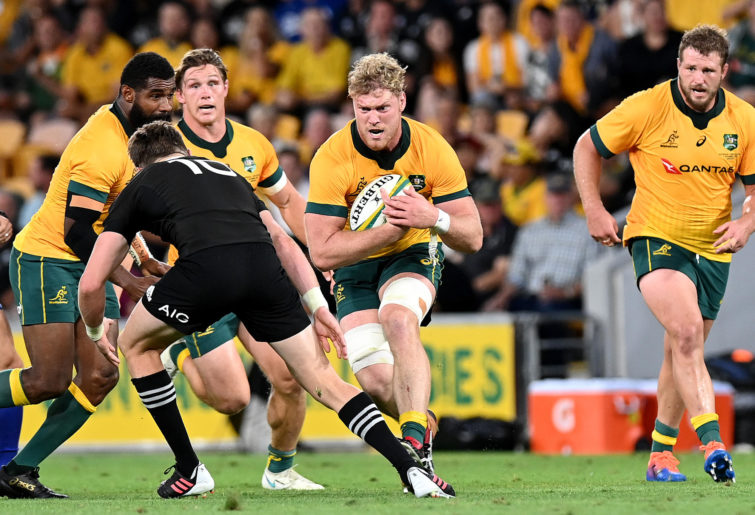
(Photo by Bradley Kanaris/Getty Images)
Public schools across the world
A well-documented example of class and elitism in rugby is documented in the histories of all leading Tier 1 nations. In New Zealand and South Africa, rugby is a religion but there is a perfect pyramid scheme of large private schools like Grey College and Kings College developing teenagers in preparation for elite rugby.
The quality of coaching and resources in these schools means that most Kiwis and South Africans are well-prepped for third-tier (NPC rugby and Currie Cup) rugby step-ups being a small bridge. Despite this, in New Zealand particularly, the game is played in most schools which assimilates into youngsters heading into club rugby too.
South Africa post-apartheid is also welcoming and encouraging more black Africans into the game through school scholarships and a strong grassroots core. For many white South Africans and Afrikaaners, the love of rugby will never be lost with them cherishing the Springboks and viewing rugby as a national game of South Africa. For all the racial and classist complications for rugby with New Zealand and SA, they have managed (politics aside) to make rugby a more inclusive game in their countries — New Zealand has achieved this partly through endorsing and embracing Maori, native and Pasifika cultures around rugby and national identity, while SA post-apartheid has gradually improved race relations and non-white inclusion in the game.
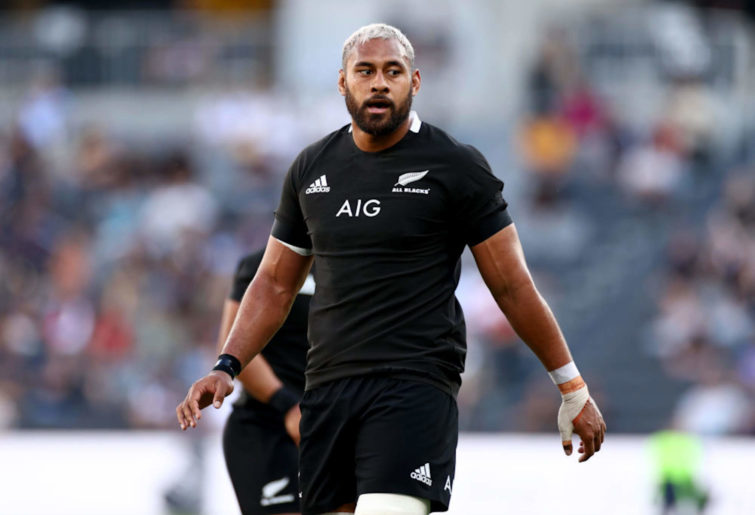
(Photo by Cameron Spencer/Getty Images)
Whilst New Zealand and SA have rugby as a national game, in England, rugby is associated as a game of the middle-upper class much like in Australia. In 2015, 21 of England’s World Cup squad attended private schools. Much of Twickenham’s (non-existent) atmosphere is heralded of old boys and their families with deep influence in business, politics and other corporate lifestyles in the country.
Australian stadiums may not be filled with these types of fans, but looking at their recent squads for Rugby Championships and the World Cup, most are dominated by GPS schools and other Sydney schools, the areas where rugby is popular at the school level is met with an abundance of cash-strapped league clubs ready to lure leading union schoolboys.
Therefore, the combination of rugby in Australia mainly being confined to public schools (sources say 16-35 per cent of the student population attend fee-paying schools) and the inability of rugby to financially compete with NRL and league means that while there may be vowing interest in bettering the Wallabies, it is a tougher system to produce a sustainably competitive Australian outfit.
Some may say that given how minor rugby is in comparison to other sports down under, it is perhaps an accomplishment that the Wallabies can regularly match and beat the All Blacks and South Africa despite not having much success in the Bledisloe for 18 years.
What can be done?
Like it or not, rugby does have a glaring class issue, none so more apparent in England and Australia. However, the reform is not just limited to grassroots and schooling, which is the first thing to revamp. Queensland and NSW will have enough appetite for rugby with GPS, Shute Shield and other grade club competitions proving popular among locals.
However, South Australia (AFL haven) and Western Australia (genuine grassroots success with Force and plenty of British/South African expats) must be targeted in a manner different to the failed Melbourne Rebels project.
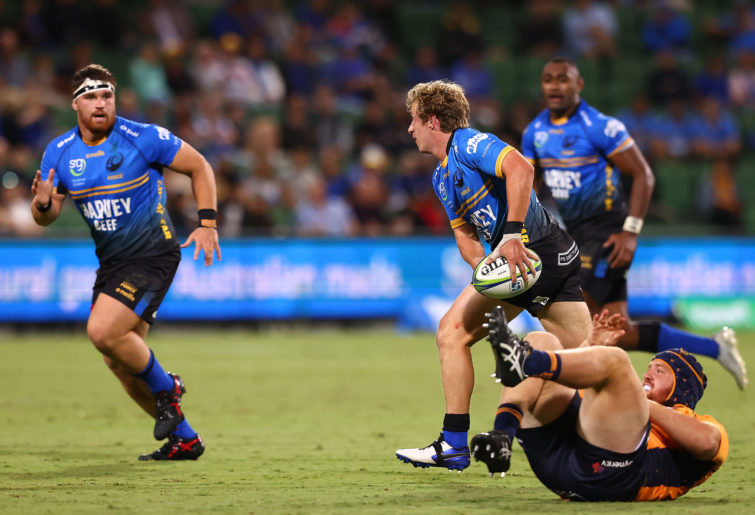
(Photo by Paul Kane/Getty Images)
Investing in these communities should be nurtured with bettering the elite coaching scheme in these areas and Super Rugby franchises — another big difference between the Kiwis and Aussies in Super Rugby and Test level is the kicking game and scrummaging — Australia has enough talent to create a classy team but for me these areas of detail are lacking. Once competent coaches are in place and this is properly developed from Test to club and schoolboy level, then the quality of a smaller playing pool can be maximised.
At the school level, it is easy to say that more schools should be encouraged to play union instead of/alongside League. Perhaps schools could coach both if possible to field a team or even launch skill sessions and workshops for League players to be able to adapt into union strategies. More importantly, the NRC needs to be bettered quality-wise or scrapped — the way I see it is a radical suggestion for Super Rugby.
Privatisation of club franchises should be allowed to bring the money at the top of the Rugby AU and into elite club and grassroots levels to allow clubs to boost their budgets for training/coaching resources, overseas player recruitments and to allow academies into schoolboy levels. Whilst this may not commercially be popular than the NRL/AFL/Big Bash, a breath of fresh air would be installed with big name drafts and a lack of financial dependence on RA.
Furthermore, there would be less of a player drain to Japan, France and the UK with more cash to be made in Australia. Like NZ’s inclusion and cultural relationship with the Maori and Pacific Islander population, there is a market for Australia to do the same.
Some of its best Wallabies have come from Pacific Island and Indigenous heritage. A franchise club embracing the Indigenous areas or culture would be a boost for the social values that rugby has. Australia benefits in all facets of the world from a multi-racial and multi-ethnic population.
Original source: https://www.theroar.com.au/2021/06/04/is-rugby-really-a-classist-and-elitist-sport/
https://therugbystore.com.au/is-rugby-really-a-classist-and-elitist-sport/
Original source: http://www.bbc.co.uk/sport/rugby-union/57335873
I don’t know if you’ve all noticed this out there in tipping land, but we’re currently in the presence of greatness.
You see, all very quietly on the far left-hand side of the panel sits a hirsute South African-American. You know him as the Roarer with beautiful prose, of engaging long reads about Springbok passion and with a borderline inappropriate man-crush on Pieter-Steph du Toit.
We just know him as the rotten sod who just can’t stop being right about rugby.
Over the last five rounds the Hairy Man has amassed 19 correct tips from 20 games. Even better, he’s 17 from 17 over the last four rounds and is yet to trip up in Trans-Tasman.
He can simply do no wrong, and with his tipping record now firmly in the spotlight, all the pressure is on to keep it going. I mean, imagine getting one wrong just as people realised how good you’re going.
In other news, the Sure Thing is back, the Blues still suck, and so again does tipping!
Last week
Harry and Dan: 5;
Digger and the Crowd: 4; and
Geoff and Brett: 3.
Overall
Harry and Dan: 47;
the Crowd: 44;
Geoff: 43;
Digger: 40; and
Brett: 37.
Crusaders, Blues, Highlanders, Brumbies, Chiefs
Having clawed my way from the depths to the top of the table, I face a tricky round with the confidence of Digger, the humility of Geoff, the serenity of Dan and the cheek of Brett.
A Force match against Crusaders in Christchurch seems a mismatch – a tough little terrier going into the lair of a grey wolf pack. Saders.
My favourite Australian team, the Reds, host my Kiwi team of choice, the Blues, for the little-known Stendhal Cup. Blues by a few, but only a few.
The Waratahs will not solve the mystery of winning in Dunedin, but nor will the Hurricanes unlock the keys to winning in Canberra.
The chastened Chiefs will rebound and dunk on the Rebels.
Sure thing
Damian McKenzie’s hair is the source of his disequilibrium.
(Photo by Kai Schwoerer/Getty Images)
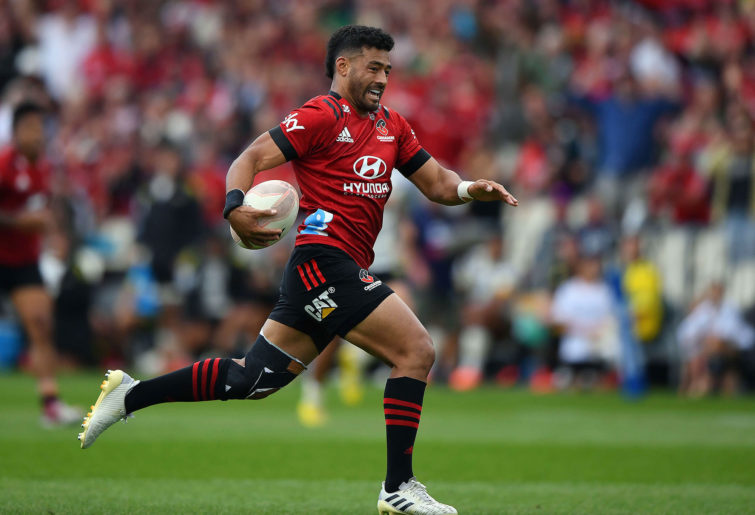
Crusaders, Blues, Highlanders, Brumbies, Chiefs
Three of this weekend’s encounters are straightforward matters. The Force don’t have anywhere near enough points in them to spring a surprise over the Crusaders, nor do the Rebels to topple the Chiefs, even though the hosts will be missing their main attacking fulcrum. The Waratahs, meanwhile, have the opposite issue: they’ll put a few tries past the Landers but concede far more in return.
The remaining two fixtures could go either way. The Reds will be buoyed by breaking their competition duck last week, but without Fraser McReight and Seru Uru coming off the bench I’m not sure they’ve picked their best possible side.
The Blues, meanwhile, have the pack to nullify – or at least break even against – the Queensland scrum and the attacking talent out wide to make the most of that advantage.
In Canberra, it just feels time for a Brumbies win. Their gruelling road trip is at an end, and they’ve shown they can match it in bursts with New Zealand’s best sides. At home, they’ll manage that for the full 80 and grab their first victory of the campaign.
Sure thing
A clear red card will be issued, and everyone will nod their heads in agreement without any complaints. Not this week, of course, but eventually.
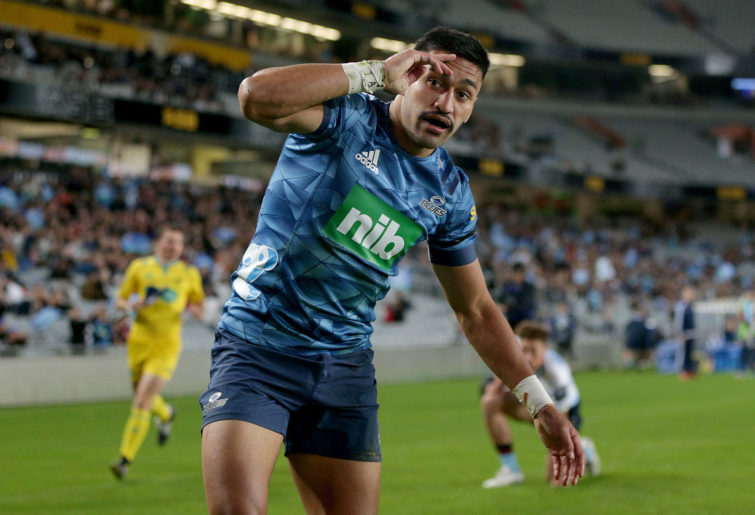
(Photo by Dave Rowland/Getty Images)
Crusaders, Blues, Highlanders, Hurricanrs, Chiefs
Unfortunately, it would appear the Force in Perth and the Force away from Perth are two completely separate entities, I am sure they will front up with a solid showing, but the Crusaders at home should be too good.
The Reds have shown they are up to the challenge this week, and it is going to be a significant challenge for the Blues in Brisbane, but I cannot shake off that second half from Townsville and will tentatively pick the Blues, who have shown good composure through their 80-minute performances in TT.
In what is clearly the match of the round, the Hurricanes have it all to do in Canberra. I fully expect the Brumbies to be much better at home, but ya know, Canes by plenty simply because they have to.
And the Rebels may just have a shot here against the Chiefs, but I am picking they might be a bit sore after last weekend, so they will bounce back, while the Highlanders should get it done over an ever-improving Waratahs outfit.
Sure thing
I fully expect a few extra balls thrown onto the field in Canberra on Saturday night from an overzealous sideline commentator in a hopeless bid to slow the game down.
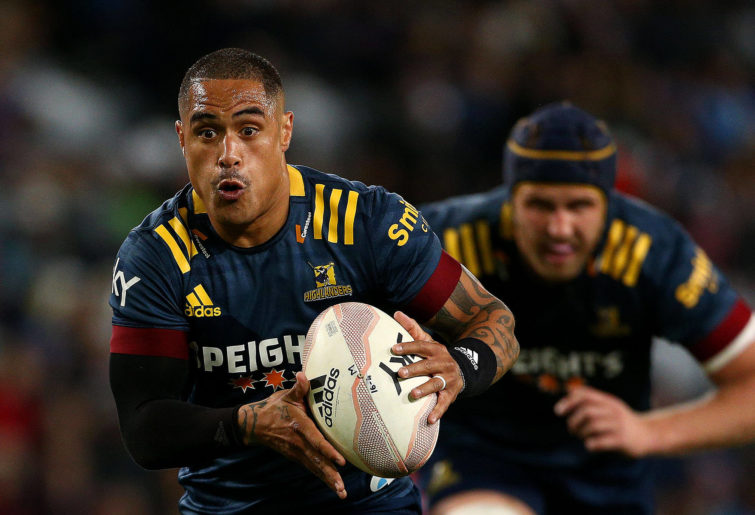
(Photo by Dianne Manson/Getty Images)
Crusaders, Blues, Highlanders, Hurricanes, Chiefs
Even at below full strength the Crusaders have the Force well covered. The match of the round comes early this week, with the Blues a more conventional match-up for the Reds, who have had their hands full defensively over the last fortnight.
This should be a great contest, but I like how the Blues are fully focused on making up for the disappointment of missing the Super Rugby Aotearoa final.
Leading into the competition, it never really felt that the Highlanders were good enough to win all five matches. But are the Waratahs the side to prove that point? Hard to be confident.
After a month on the road, the Brumbies will be better for being at home. Much better. And the Canes are due to throw in a wobbly one. But it’s a coin toss to the visitors.
There’s no reason why the Rebels won’t keep improving, particularly if Jordan Uelese remembers to engage his brain this week. But that’s not enough to tip them against the Chiefs, who will test them with their speed and agility on the counter.
Sure thing
Extended lockdown in Melbourne is wreaking havoc. There are only so many times you can rewatch John Cena apologise for calling Taiwan a country just to avoid the politicians and public servants. We need more rugby to fill in our days. Make this a double round!
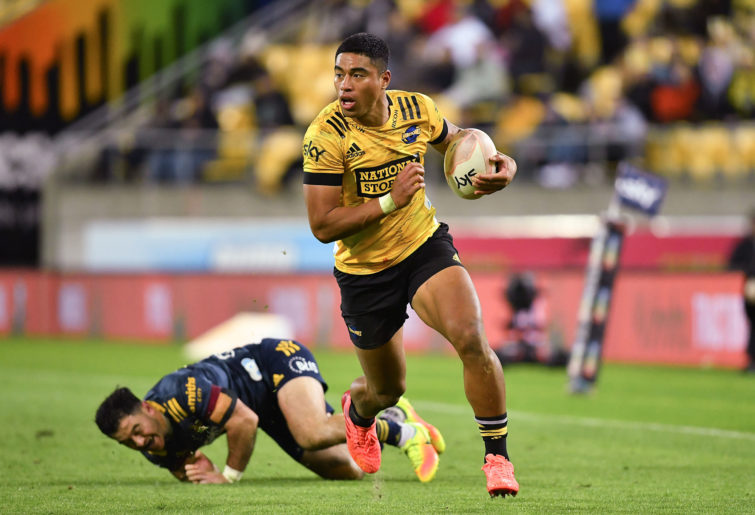
(Photo by Mark Tantrum/Getty Images)
Crusaders, Reds, Highlanders, Brumbies, Chiefs
Well, there’s another tipping season blown. Like the rest of them, it will soon be chargrilled until it’s got a darker side than Darth Vader before being tossed aside and discarded like unwanted TV content at a sports network.
This week the Force will find out firsthand just how good the Crusaders depth is, as tackle bag holders, assistant coaches and possibly even some actual tackle bags show skill sets to die for.
Somehow I’m the only one to pick the Reds, but I look it a completely different way: I’m the only one who won’t be disappointed after giving the Blues the benefit of considerable doubt.
Waratahs games this series have so far comprised 17 tries, ten tries and 11 tries, and I genuinely think we’ll see another number within that range on Saturday. Of course how many of them the Highlanders score will come down to the Waratahs’ attitude in defence, which sadly has been absent like a few senior names this season.
The Hurricanes suddenly find themselves staring pressure in the face for the first time in a good while, and they’re nervous about it, because they still know themselves they can be a bit flaky. And now they face a wounded Brumbies looking at five consecutive losses for the first time since 2018 and only the second time in a decade.
Oh, and winter has arrived in Canberra, let me tell you. And winter in Canberra might be enough of a reason for the Chiefs to win in Hamilton too, come to think of it.
Sure thing
Poor old Nic Berry is merely running the line in Brisbane this weekend, but by the end of it he’ll be solely responsible for forward passes in Christchurch, scrum penalties in Dunedin, high tackles in Hamilton and winter in Canberra.
| TT-4 | Harry | Brett | Dan | Digger | Geoff | The Crowd |
|---|---|---|---|---|---|---|
| CRU v FOR | CRU | CRU | CRU | CRU | CRU | ? |
| RED v BLU | BLU | RED | BLU | BLU | BLU | ? |
| HIG v WAR | HIG | HIG | HIG | HIG | HIG | ? |
| BRU v HUR | BRU | BRU | BRU | HUR | HUR | ? |
| CHI v REB | CHI | CHI | CHI | CHI | CHI | ? |
| Last week | 5 | 3 | 5 | 4 | 3 | 4 |
| Overall | 47 | 37 | 47 | 40 | 43 | 44 |
Get your votes in now – the Crowd’s tips will be revealed Friday afternoon AEST.
if (!Element.prototype.matches) document.addEventListener("DOMContentLoaded", function() var request = new XMLHttpRequest(); request.open('POST', '/wp-admin/admin-ajax.php', true); request.setRequestHeader('Content-Type', 'application/x-www-form-urlencoded;'); request.onload = function () if (this.status >= 200 && this.status < 400) document.getElementById("at-submit-tips-inner").innerHTML = this.response; document.addEventListener('click', function (event) if (!event.target.matches('.margin-tap-targets span')) return; var match = event.target.getAttribute('data-match'); var points = event.target.getAttribute('data-points'); var marginField = document.getElementById('at-margin-'+match); marginField.value = marginField.value*1 + points*1; , false); else console.log(this.response); ; request.onerror = function() // Connection error ; request.send('action=at_insert_submit_tips&title=Your Tips&comp_id=8&round_id='); );Original source: https://www.theroar.com.au/2021/06/03/super-rugby-tipping-panel-week-16-try-stopping-the-frontrunning-hairy-man/
The immediate post-match interview with a soccer manager in the UK is a hot-house of sporting cliches.
In an exciting game, there is “a lot of end-to-end stuff”, if a player has a bad patch he expects “the hair-dryer treatment” after the game. A surprising loss is framed as “there are no easy games at this level”, while an unexpected shift in momentum translates to “it was a game of two halves”.
They even speak in a curious present tense about a past which can no longer be changed – “he’s hit it with his left foot and it’s curled into the top corner”. It is as if they are still reliving the game in an endless, purgatorial loop. As the comedian Michael McIntyre once pointed out, everything happens to football managers “at the end of the day” – even if it happened first thing in the morning.
Whenever you hear the interviewee slip into soccer vernacular, it is the time to switch off. You can kiss any further value to the commentary goodbye after that.
An entirely genuine game of two halves did occur between the Reds and the Chiefs in Saturday’s Trans-Tasman encounter in Townsville. For once, the cliche was spot on.
The Reds won the first half 33-3. The Chiefs won the second just as decisively, 31-7. With 13 or 14 Chiefs on the field the score was 26-3 to Queensland, but with the Mooloo men restored to a full complement it was turned on its head: 14-31 to the visitors.
The basic stats tell the same see-saw story, with the Chiefs subsisting on a beggar’s ration of ball in the first half – sub 30 per cent in both territory and possession – then coming back to dominate the second period and shut the Reds out of the game.
It can be difficult to evaluate games like this. Do you attach more importance to the early lead accumulated against an understrength opponent (“we took our foot off the pedal”), or to the comeback (“we were caught napping at the start”)? Pick your poison.
Although Rugby Australia and the promoters of the Trans-Tasman competition will be letting out a mighty sigh of relief after events in Townsville, Brad Thorn and his Reds will be much more wary after the shine of their first win wears off. Queensland have conceded an average of over 44 points and seven tries per game in their three outings so far – and two of those have been at home.
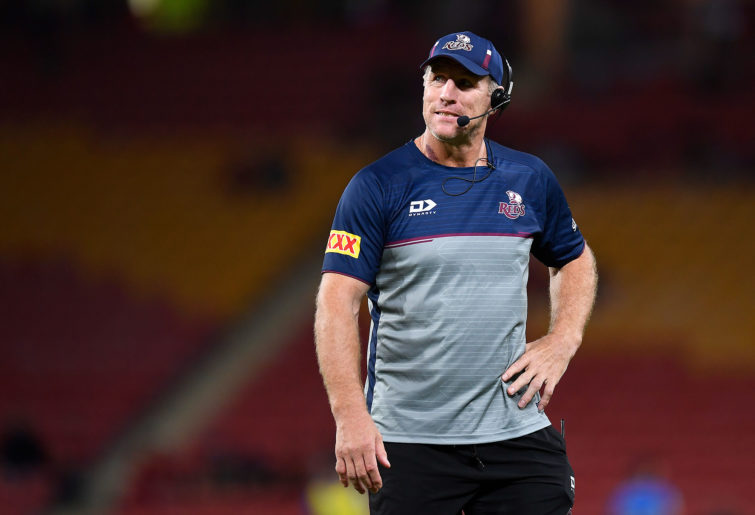
Brad Thorn. (Photo by Albert Perez/Getty Images)
The Reds can certainly find the tryline, but they are unable to stop New Zealand teams scoring against them. Much of the reason for this is Queensland’s dependence on the kicking game: the Reds kicked the ball on 29 occasions in Townsville, 12 times more than their opponents. Despite spending 30 minutes with only 13 or 14 men on the field, the visitors made more runs, passes and offloads than the home team.
The Reds like to scrum, and their tight forwards are built for the job, but they only get an average of five tackles per game out of two positions in the front row, at a completion rate of 57 per cent. This is a big part of the explanation why the emphasis on the kicking game produces uneven results.
The kicking strategy has to be right, but so does the chase. Over the weekend, the Reds started the game accurately on both counts. Their exits were tight:
Harry Wilson cuts a nice angle between two Chiefs forwards to make the initial break all the way up to the 40-metre line, and the Reds immediately insert their primary kicker, Bryce Hegarty, at first receiver to get maximum length on the following kick. No kick return, no scoring comeback.
Queensland held onto this position within the Chiefs’ 22 long enough to create the first try of the game three minutes later. That is what a good exit can do for you.
The Reds continued to kick on their own terms in the first period:
This time a drive straight from the kick-off takes play up towards halfway, and Hegarty is once again the main focus of the kicking game, with a long diagonal giving Suliasi Vunivalu a decent shot at taking man and ball together.
Like their exit strategy, the Reds’ first half chase was good:
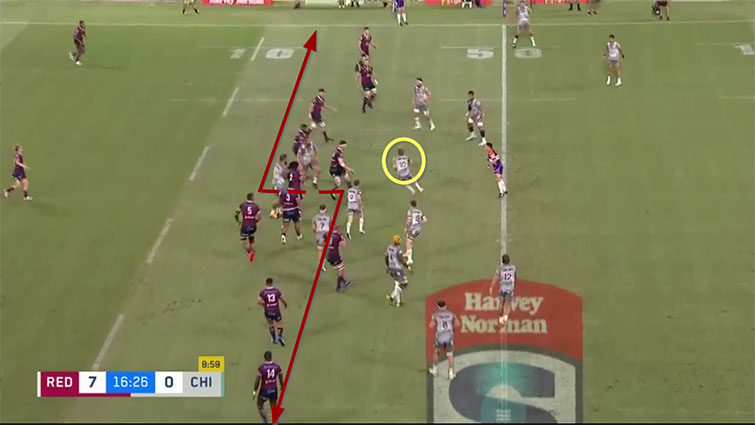
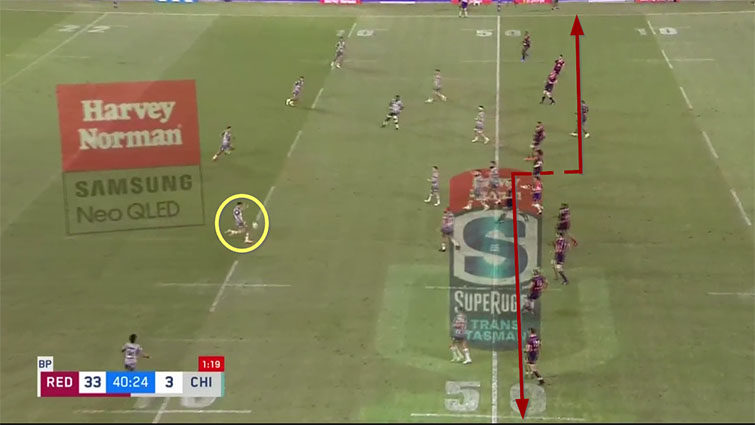
There is excellent connectivity and numbers, with no more than five metres separating the point chase and hindmost defender. That forces a kick back in the second example, and leaves Damian McKenzie with nowhere to go in the first.
The exit strategy was, of course, helped greatly by the absence of two important components of the Chiefs backfield, Chase Tiatia and McKenzie, for half an hour.
Both cards by Nic Berry were brave and fully justified:
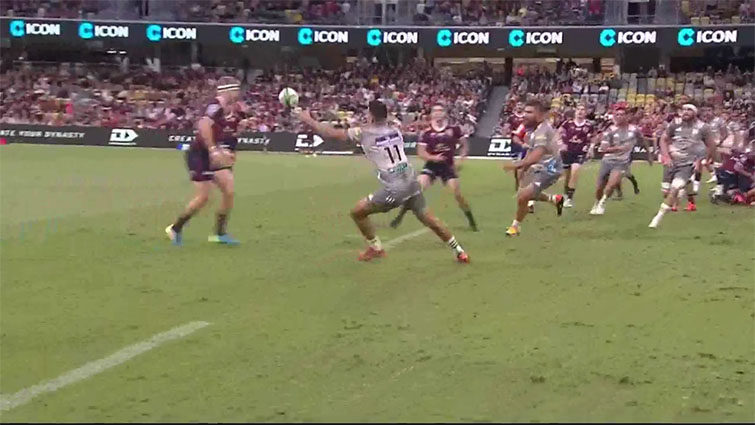
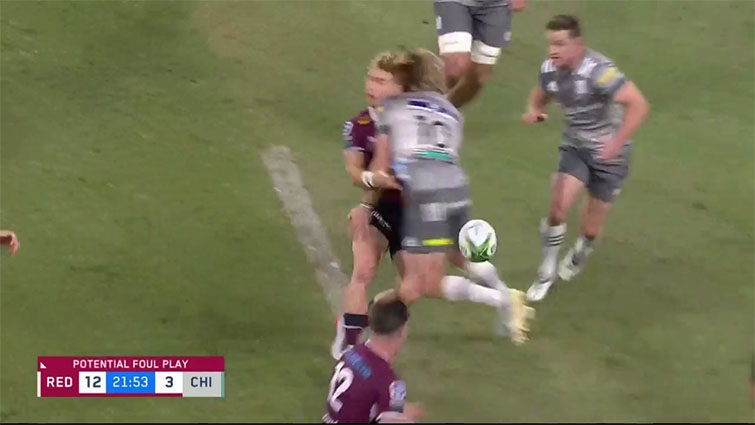
There is no prospect of Chase Tiatia catching the ball on the end of his fingers, so the deliberate knock-on deserves a yellow card. Likewise, McKenzie would have been fully aware of the current refereeing protocol about direct contact to the head in the tackle. He would have known his fate in advance, even if his captain Brad Weber looked shocked.
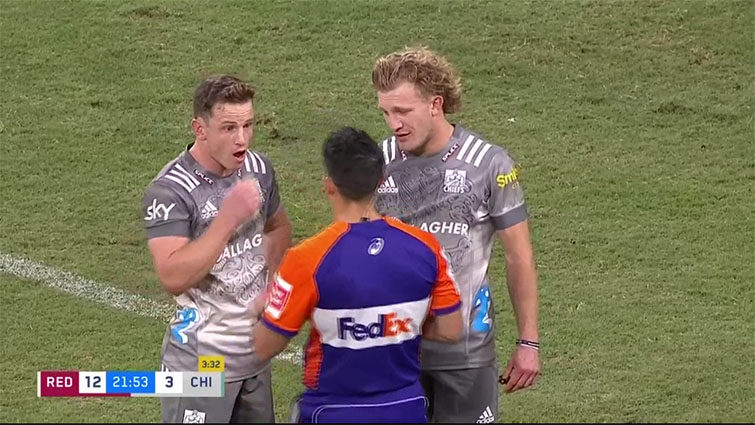
It is a melodramatic cliche of a grimace of which any soccer player would be proud.
Of much greater concern for the Reds was the ease with which their defence was broken down by a Chiefs attack lacking its main creative influence in the second period.
Even with Kaleb Trask as the sole playmaker, they were able to start making demands of the Queensland tight forwards on defence – demands they could not meet:
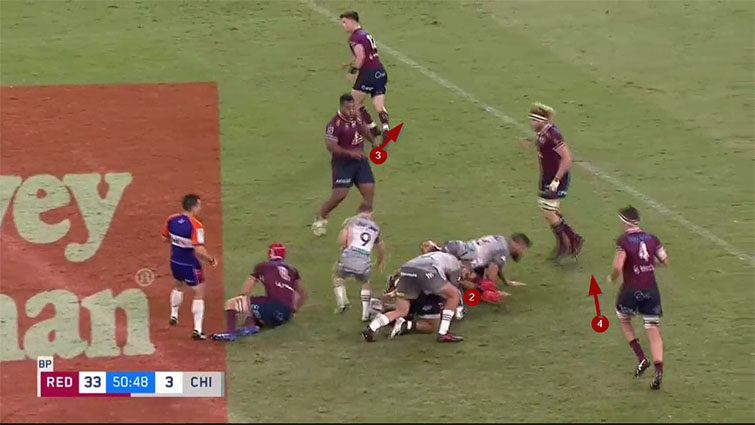
These two phases occurred within the same sequence of play. In both cases, a simple cut-out pass in midfield takes the Queensland tight forwards out of the game.
In the first instance, Brandon Paenga-Amosa falls into the tackle unnecessarily and Taniela Tupou is still struggling to realign when Tiatia makes the mini-break in between him and Isaac Henry. In the second, Harry Wilson runs past both Paenga-Amosa and Dane Zander to (at least) challenge Pita Gus Sowakula in the corner.
Another flat cut-out pass to take out the key defender, Wilson, and leave Zander slow on the wrap-around to the far side; another cut by Tiatia into the inviting space between Henry and Angus Scott-Young. That sets the scene for the try-scoring phase, with only Wilson showing any animation at all in defence.
The final nail occurred only one minute from time:
Luckily for the Reds, it was just a nail on which to hang a picture about the ability of their tight forwards, not one hammered into their coffin.
Summary
If Brad Thorn was a soccer manager in the UK, he would probably have said something along the lines of, “It was a game of two halves, wasn’t it? We scored a few early doors but struggled to shut up shop in the second half. We should have parked the bus.”.
In fact, he came pretty close anyway.
“Hats off to the Chiefs, they kept plugging away and got to within a try of winning the game,” he said.
“I felt like the guys who started the game today did a heck of a job and played some good footy.
“I wasn’t happy with my finishers tonight.
“The job is to come on and add, and body language and where they were at, they took the foot off the throat… That’s footy and we’ll move on.”
Behind closed doors, he will probably be more concerned about the 14-31 scoreline when both teams were at full strength, rather than rejoicing in the points accumulated during their numerical advantage.
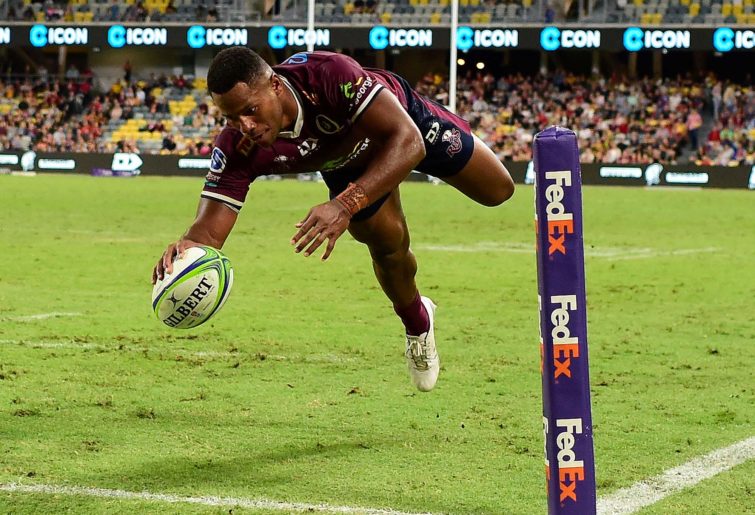
Filipo Daugunu. (Photo by Ian Hitchcock/Getty Images)
The tight forwards at the Reds are built to scrum, and they got pay from the set-piece early on – especially after the Chiefs had mystifyingly left the mountainous Samisoni Taukei’aho out of their starting front row in favour of Brad Slater. Taukei’aho is a Samson of the scrum indeed.
During the first half, the exit strategy and kick-chase held together well. But as the second period wore on, the Queensland tight forwards wore down like a clockwork toy, and their defence ended up looking no better than it had against the Crusaders right from the start.
The defensive work rate of their second row has shown a big upswing in the Trans-Tasman, but the front row makes an average of only seven tackles per man per game, and their completion percentage is way, way down at 72 per cent.
To give that figure some context, the Chiefs average ten tackles per man per game at a completion rate of 89 per cent. The Crusaders are even higher, with 12.5 tackles at 86 per cent. With the amount of ball that Queensland kick away, they cannot afford this kind of outcome.
Will Australia’s top provincial team end the Trans-Tasman tournament feeling over the moon, or as sick as a parrot? There are more twists and turns to come in the road from Townsville – but for now, a win is a win, and it’s a results-driven business.
Original source: https://www.theroar.com.au/2021/06/02/why-there-are-more-townsville-twists-and-turns-to-come-for-the-reds-in-super-rugby-trans-tasman/
